

What research says
3 studies · 1 review · summaries checked against each study · How we choose studiesChecked automatically against the study
Swings worked your inner hamstring a bit harder than your outer hamstring.
Inner hamstring worked harder than outer hamstring during swings, a medium-sized difference across 619 people
This was a review that pooled many studies, with 619 healthy adults in total. It used sensors on the skin to measure how hard the inner and outer parts of the back of the thigh work. It did not measure muscle growth. During kettlebell swings, the inner hamstring worked harder than the outer hamstring. The authors say the ways of measuring varied a lot, so firm conclusions are hard to draw.
Who took part619 healthy adults; the abstract doesn't say their sex, age or training experienceLimitsIt measured how hard muscles work, not muscle growth or strength.The authors say the studies measured muscle work in different ways, so firm conclusions are hard to draw.The abstract doesn't say how many studies were pooled.
Why this bandA review that pooled 619 studiesTests this exercisePublished recently, so not yet widely cited
- Expect swings to work the back of your thighs, especially the inner side.
- If you want to work the outer side too, add a move like lying leg curls, which worked it harder in this review.
- Kind of study
- A review
- Studies pooled
- 619
- What they looked at
- Muscle activity
Original title: Differences in activation amplitude between semitendinosus and biceps femoris during hamstring exercises: A systematic and critical review with meta-analysis
Sahinis C, Amiridis IG, Enoka RM, Kellis E · Journal of Sports Sciences · Mon Apr 7 2025 · DOI 10.1080/02640414.2025.2486879
Checked automatically against the study
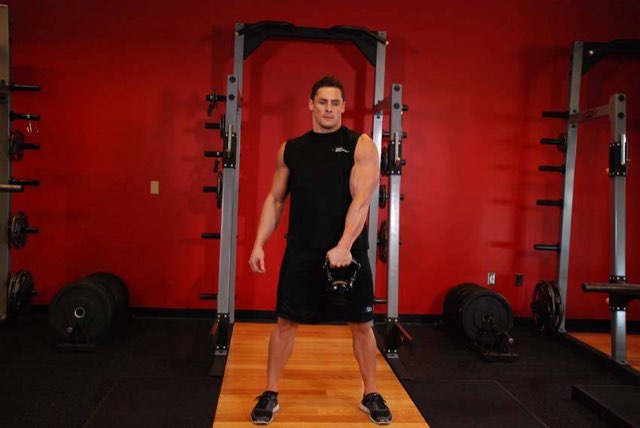
Six weeks of swings built squat strength and jump height as well as jump squats did.
The most people could half squat once went up 9.8% in 6 weeks, the same as jump-squat training
This was a fair test with 21 healthy young men who could already squat well. They trained twice a week for 6 weeks. Some did swings in rounds of 30 seconds on and 30 seconds off. The rest did jump squats. Both groups got stronger and jumped higher, and both improved by about the same amount.
Who took part21 healthy men aged 18 to 27 who could already half squat well; no womenLimitsIt was a small group.Only young men took part.There was no group that didn't train, so it compared swings with jump squats only.
Why this bandA randomised trial of 21 peopleAbout this exercise: it’s in the title6 weeks of trainingAmong the top 5% most cited papers of its age
- Do 12 rounds of swings, 30 seconds on and 30 seconds off, twice a week.
- Use a 12 kg bell if you weigh under 70 kg, or a 16 kg bell if you weigh more. That's what this study used.
- Kind of study
- A fair test
- People
- healthy young men who could squat
- What they looked at
- Strength, performance
Original title: Kettlebell swing training improves maximal and explosive strength
Lake JP, Lauder MA · Journal of Strength and Conditioning Research · Wed Aug 1 2012 · DOI 10.1519/jsc.0b013e31825c2c9b
Checked automatically against the study
One short swing session made lower back and hip muscles less sensitive to pressure.
60 people did 8 rounds of 20-second swings; no size of effect was reported
This was a fair test (people were split into groups by chance) with 60 healthy young adults. One group warmed up and then did 8 rounds of swings, each 20 seconds long with 10 seconds of rest. The other group only warmed up. Right after, the swing group felt pressure on their lower back and hip muscles as less unpleasant than the warm-up-only group did.
Who took part60 healthy young adults (23 men, 37 women); training experience not statedLimitsIt only measured the effect right after one session.It measured how sensitive muscles were to pressure, not strength or fitness.Everyone was healthy, so it doesn't tell us about people with pain.
Why this bandA randomised trial of 60 peopleAbout this exercise: it’s in the titleAmong the top 12% most cited papers of its age
- After your warm-up, try 8 rounds of swings: 20 seconds on, then 10 seconds of rest.
- This study only looked at healthy people right after one session. If you have back pain, talk to a qualified health professional.
- Kind of study
- A fair test
- People
- healthy young adults
Original title: The Short-Term Effect of Kettlebell Swings on Lumbopelvic Pressure Pain Thresholds: A Randomized Controlled Trial
Keilman BM, Hanney WJ, Kolber MJ and others · Journal of Strength and Conditioning Research · Wed Nov 1 2017 · DOI 10.1519/jsc.0000000000001743
How studies shape Body CEO
Every summary here is checked against its study before it appears: the numbers come from the study, with no promises. 316 studies in use, across 97 exercises, and this one was last checked for new research on Fri Nov 13 2026. How we review research
- 1 · FoundOn PubMed, checked for retractions
- 2 · WeighedScored Strong, Moderate or Early
- 3 · ReadPut in plain words, every number checked
- 4 · Shapes your planStrong and Moderate takeaways guide sets, reps and rest
- 5 · Eliza cites itReads our approved studies first, with the study linked