

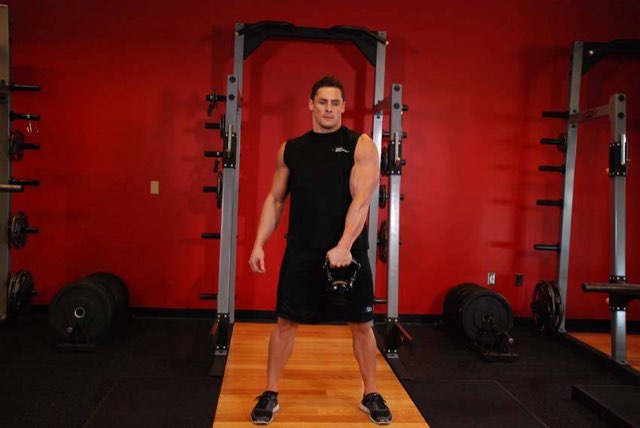
Swings against jump squats, twice a week for 6 weeks
Say you have 12 minutes and a kettlebell. You could swing it, or you could put it down and do jump squats. Does the choice matter if you want to get stronger and jump higher?
Researchers Lake and Lauder tested this in a randomized trial. Twenty-one healthy men, aged 18 to 27, took part. All of them could already do a proficient half squat. No women were in the study.
Before training, each man was tested on strength and on jumping. Strength was his half squat 1RM, the heaviest load he could lift for a single repetition. Jumping was his vertical jump height. Then the men were randomly split into a swing group and a jump squat group. Both groups trained twice a week for 6 weeks.
The swing group did 12 rounds of 30 seconds of swinging and 30 seconds of rest. That makes a 12-minute bout. Men under 70 kg used a 12 kg kettlebell. Men over 70 kg used a 16 kg one.
The jump squat group did at least 4 sets of 3 jumps. They used the load that gave them their top power. Sets and reps changed with the load. The heaviest load was 60% of 1RM, done for 4 sets of 3. The lightest load was 0%, done for 8 sets of 6. Everyone was tested again after the 6 weeks.
Both groups improved, and the study could not tell them apart
Across all 21 men, maximum strength rose by 9.8%. Half squat 1RM went from 165% of body mass to 181%. A p-value below 0.001 means a change that large is very unlikely to be luck.
Jump height rose by 19.8%, from 20.6 cm to 24.3 cm. Again, that is the change for the whole group together.
The key comparison is between the types of training. The researchers found no significant difference for strength (p = 0.56) or for jump height (p = 0.38). In plain terms, neither group clearly beat the other.
That is not the same as showing the methods are equal. With only 21 men, a small real gap could be hidden. What the data do show is that swings gave gains in the same range as jump squats, a method already known to build both.
What this means for you
If you are a young man who already squats well, swings look like a reasonable way to add variety. In this study, 12 minutes of swings, twice a week, moved squat strength and jump height about as much as jump squats did.
The evidence is thinner for everyone else. No women took part. Beginners, older lifters, and people who can't yet squat proficiently were not studied. Your results could differ.
Your goals and your gear can decide the rest. Swings need only a kettlebell and little space. Jump squats may suit you if you want to practice jumping itself, or if you like loading a barbell.
Here is a Body CEO suggestion, which the study did not test. If you try swings, test your squat and your jump before you start and again after 6 weeks. Then you can see what happened for you, not just for 21 other men.
- It was a small group.
- Only young men took part.
- There was no group that didn't train, so it compared swings with jump squats only.
What this study can't answer
The biggest gap is that there was no group that didn't train. Both groups improved, but the study can't say how much of the gain came from swings alone. Some may come from practicing the tests or from other factors. A study with a no-training group would be needed to separate those.
It also can't say whether swings and jump squats are truly equal. That would take a larger study that could pick up a small difference.
Finally, 6 weeks is short. Studies of women, of older people, and of longer training would show whether the same pattern holds over months, and for other outcomes such as sprinting.
The measurements
Read each row left to right: where the men started, where they ended up, and whether the training types differed. The before and after values are for all 21 men together, as the abstract reports them.
| Measure | Before | After | Change | Swings vs jump squats |
|---|---|---|---|---|
| Half squat 1RM (% of body mass) | 165% | 181% | 9.8% | No significant difference (p = 0.56) |
| Vertical jump height | 20.6 cm | 24.3 cm | 19.8% | No significant difference (p = 0.38) |
The abstract doesn't say whether the before and after values are averages, and it gives no per-group numbers. "No significant difference" means the study didn't find a clear gap. It does not show that no gap exists. The men were healthy, aged 18 to 27, and already good at half squats.
Written with Ronan Diego, Head of Health Programs at Mindvalley, Certified Mindvalley Coach. Written in our own words from the study’s abstract: the full paper isn’t open to read.
Body CEO educational article · Editorial review pending · Updated Sun Nov 22
This page explains research for general wellness. It isn’t personal training or medical advice.