

What research says
2 studies · summaries checked against each study · How we choose studies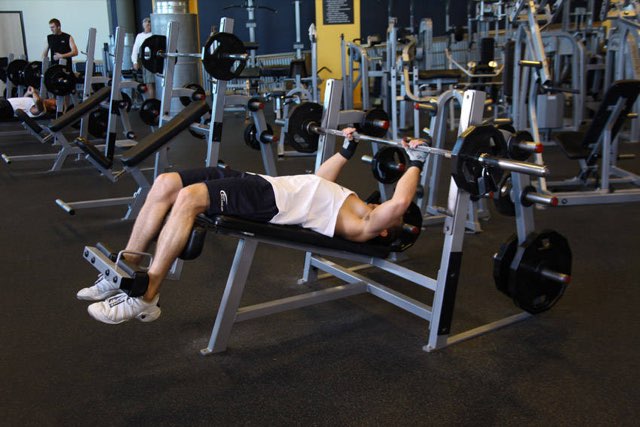
Checked automatically against the study
How fast the bar moves shows how close you are to your max.
Bar speed matched share of max with a fit score of 0.94, and 0.99 on each person's own chart.
This was a small lab test with 12 young, healthy men and women. Each person worked up to the most they could lift once on the decline bench. The researchers found bar speed matched the share of max lifted very closely. The match was even closer when men and women were looked at separately. It was closest of all when each person had their own chart.
Who took part12 young healthy men and women; the split by sex, age and lifting experience aren't givenLimitsVery small group of 12 people.A one-time lab test, not weeks of training.The abstract doesn't say how experienced the lifters were.
Why this bandA one-off lab test of 12 peopleAbout this exercise: it’s in the titleAmong the top 7% most cited papers of its age
- Use a bar speed tracker, if you have one, to judge how heavy a set really is for you that day.
- Build your own speed chart from your own lifts. A general chart for everyone is less exact.
- Kind of study
- A lab study
- People
- young healthy men and women
- What they looked at
- Strength, performance
Original title: Sex-related differences in the load-velocity and load-power relationships of the decline bench press exercise
Valdés-Álvarez A, Nieto-Acevedo R, Rojo-Tirado MÁ · Journal of Sports Sciences · Mon Jul 1 2024 · DOI 10.1080/02640414.2024.2386207
Checked automatically against the study
Leg vibration during decline bench raised triceps effort and power on heavier sets.
Peak power rose with vibration at 70% of max, but not at lighter weights. No size of effect was reported.
This was a one-session lab test with 47 young, active male students. They did decline bench press with and without vibration on their legs, held in a hamstring bridge. Sensors on the skin measured how hard muscles worked, not muscle growth. With vibration, the triceps worked harder at every weight, but the chest did not. Peak power went up only with the heaviest weight tested.
Who took part47 young, active, healthy male students; no womenLimitsOnly men took part.A one-time lab test, not weeks of training.It measured how hard muscles worked, not muscle growth or strength gains.
Why this bandA one-off lab test of 47 peopleAbout this exercise: it’s in the titleAmong the top 13% most cited papers of its age
- Don't count on leg vibration to make your chest work harder. In this study, it didn't.
- If you try it, use it on heavier sets, around 70% of the most you can lift once. That is where power went up.
- Kind of study
- A lab study
- People
- young active male students
- What they looked at
- Muscle activity, performance
Original title: Effects of whole-body vibration applied to lower extremity muscles during decline bench press exercise
García-Gutiérrez MT, Hazell TJ, Marín PJ · Journal of Musculoskeletal & Neuronal Interactions · Wed Sep 7 2016 · PubMed 27609035
How studies shape Body CEO
Every summary here is checked against its study before it appears: the numbers come from the study, with no promises. 316 studies in use, across 97 exercises, and this one was last checked for new research on Fri Nov 13 2026. How we review research
- 1 · FoundOn PubMed, checked for retractions
- 2 · WeighedScored Strong, Moderate or Early
- 3 · ReadPut in plain words, every number checked
- 4 · Shapes your planStrong and Moderate takeaways guide sets, reps and rest
- 5 · Eliza cites itReads our approved studies first, with the study linked