

Research on Decline Bench Press · Every study we found · How we choose studies
Checked automatically against the study
Leg vibration during decline bench raised triceps effort and power on heavier sets.
Peak power rose with vibration at 70% of max, but not at lighter weights. No size of effect was reported.
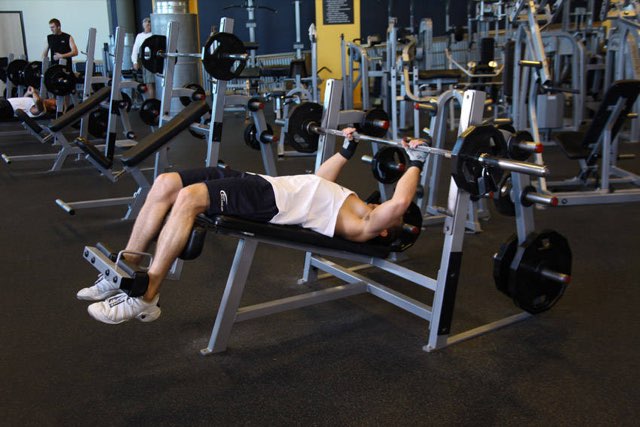
This was a one-session lab test with 47 young, active male students. They did decline bench press with and without vibration on their legs, held in a hamstring bridge. Sensors on the skin measured how hard muscles worked, not muscle growth. With vibration, the triceps worked harder at every weight, but the chest did not. Peak power went up only with the heaviest weight tested.
Who took part47 young, active, healthy male students; no womenLimitsOnly men took part.A one-time lab test, not weeks of training.It measured how hard muscles worked, not muscle growth or strength gains.
Why this bandA one-off lab test of 47 peopleAbout this exercise: it’s in the titleAmong the top 13% most cited papers of its age
- Don't count on leg vibration to make your chest work harder. In this study, it didn't.
- If you try it, use it on heavier sets, around 70% of the most you can lift once. That is where power went up.
- Kind of study
- A lab study
- People
- young active male students
- What they looked at
- Muscle activity, performance
Original title: Effects of whole-body vibration applied to lower extremity muscles during decline bench press exercise
García-Gutiérrez MT, Hazell TJ, Marín PJ · Journal of Musculoskeletal & Neuronal Interactions · Wed Sep 7 2016 · PubMed 27609035