

What research says
2 studies · summaries checked against each study · How we choose studies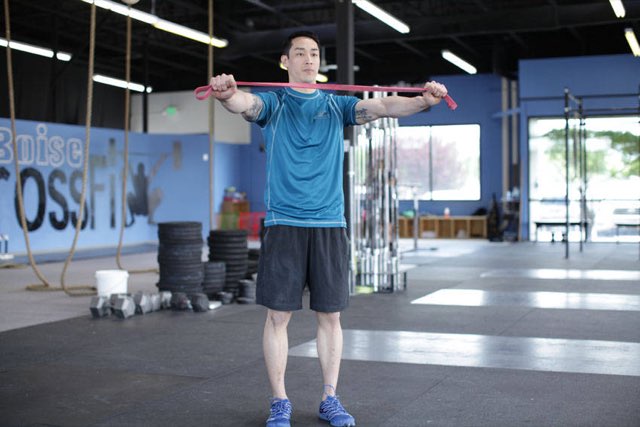
Checked automatically against the study
Doing pull-aparts in a squat made your middle and lower upper back work harder.
Middle upper back worked about 9.7% of max effort harder in a squat than standing
This was a short lab study. 18 people had a head that sat forward of the shoulders on photos, and 18 didn't. Everyone did band pull-aparts while standing, balancing on a single leg, in a squat, in a squat on a single leg and in a split squat. Sensors on the skin measured how hard the neck and upper back muscles worked.
Who took part18 people with a forward head position and 18 without. The abstract doesn't say their sex, age or training experience.LimitsA short lab test, not weeks of trainingMeasured how hard muscles worked, not growth or strengthThe abstract doesn't say who the people were by age, sex or training
Why this bandA one-off lab test of 36 peopleTests this exerciseAmong the top 7% most cited papers of its age
- Hold a squat while you do your pull-aparts. This shifts more work to the middle and lower parts of your upper back.
- Try the squat version if you want your neck and the top of your shoulders to do less of the work.
- Kind of study
- A lab study
- People
- adults with and without a forward head position
- What they looked at
- Muscle activity
Original title: Investigation of muscle activation during kinetic chain based exercises in individuals with and without forward head posture
Cobanoglu G, Guzel NA, Ecemis ZB, Demirkan MY · Journal of Back and Musculoskeletal Rehabilitation · Mon Jan 1 2024 · DOI 10.3233/bmr-230397
Checked automatically against the study
How you turn your palms and which way you pull changes which shoulder muscles work.
Muscles worked at 15.3% to 72.6% of their max effort, depending on grip and direction
This was a small lab study with 10 healthy men. They did band pull-aparts with three hand positions and three pull directions. Sensors on the skin measured how hard five upper back and shoulder muscles worked. It did not measure muscle growth or strength.
Who took part10 healthy men, about 36 years old on average; no women. Training experience isn't stated.LimitsVery small group of only menA short lab test, with only three reps of each versionMeasured how hard muscles worked, not growth or strength
Why this bandA one-off lab test of 10 peopleAbout this exercise: it’s in the titleIn a recognised free-to-read journal (DOAJ)Among the top 13% most cited papers of its age
- Turn your palms up if you want more work in your lower traps (the lower part of your upper back) and the small muscle on the back of your shoulder blade.
- Try pulling on a diagonal up and out. This direction made most of the measured muscles work hardest.
- Kind of study
- A lab study
- People
- healthy adult men
- What they looked at
- Muscle activity
Original title: Band Pull-Apart Exercise: Effects of Movement Direction and Hand Position on Shoulder Muscle Activity
Fukunaga T, Fedge C, Tyler T and others · International Journal of Sports Physical Therapy · Sat Apr 2 2022 · DOI 10.26603/001c.33026
How studies shape Body CEO
Every summary here is checked against its study before it appears: the numbers come from the study, with no promises. 316 studies in use, across 97 exercises, and this one was last checked for new research on Fri Nov 13 2026. How we review research
- 1 · FoundOn PubMed, checked for retractions
- 2 · WeighedScored Strong, Moderate or Early
- 3 · ReadPut in plain words, every number checked
- 4 · Shapes your planStrong and Moderate takeaways guide sets, reps and rest
- 5 · Eliza cites itReads our approved studies first, with the study linked