

Research on Band Pull-Apart · Every study we found · How we choose studies
Checked automatically against the study
Doing pull-aparts in a squat made your middle and lower upper back work harder.
Middle upper back worked about 9.7% of max effort harder in a squat than standing
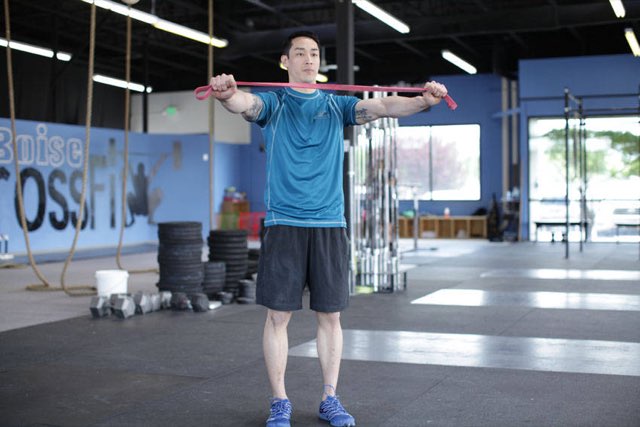
This was a short lab study. 18 people had a head that sat forward of the shoulders on photos, and 18 didn't. Everyone did band pull-aparts while standing, balancing on a single leg, in a squat, in a squat on a single leg and in a split squat. Sensors on the skin measured how hard the neck and upper back muscles worked.
Who took part18 people with a forward head position and 18 without. The abstract doesn't say their sex, age or training experience.LimitsA short lab test, not weeks of trainingMeasured how hard muscles worked, not growth or strengthThe abstract doesn't say who the people were by age, sex or training
Why this bandA one-off lab test of 36 peopleTests this exerciseAmong the top 7% most cited papers of its age
- Hold a squat while you do your pull-aparts. This shifts more work to the middle and lower parts of your upper back.
- Try the squat version if you want your neck and the top of your shoulders to do less of the work.
- Kind of study
- A lab study
- People
- adults with and without a forward head position
- What they looked at
- Muscle activity
Original title: Investigation of muscle activation during kinetic chain based exercises in individuals with and without forward head posture
Cobanoglu G, Guzel NA, Ecemis ZB, Demirkan MY · Journal of Back and Musculoskeletal Rehabilitation · Mon Jan 1 2024 · DOI 10.3233/bmr-230397