

What research says
2 studies · summaries checked against each study · How we choose studies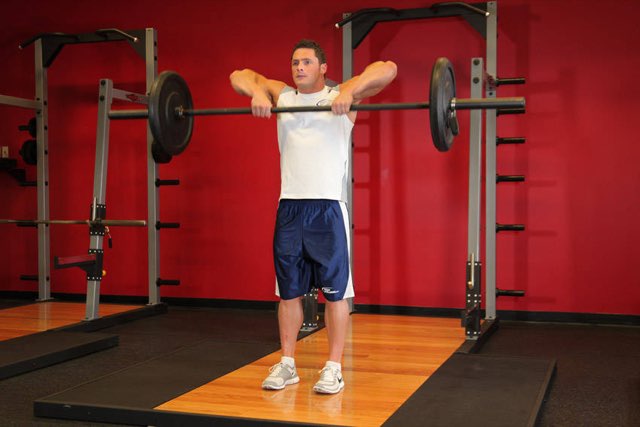
Checked automatically against the study
Upright rows made the upper back and shoulder muscles work hard with light weights.
Upper back muscle worked at 85% of its all-out effort in the upright row, close to shrugs at 102%
This was a small one-session lab study of 12 women workers aged 30 to 60 who had long-lasting neck muscle pain. Sensors on the skin measured how hard the upper back and shoulder muscles worked during five exercises. The upper back muscle worked close to its all-out effort in the upright row. People used much lighter weights for this than for shrugs. It measured muscle effort, not muscle growth.
Who took part12 women workers, 30 to 60 years, with long-lasting neck muscle pain; no men; training experience not statedLimitsSmall group of 12 peopleOnly women with neck pain, so it may not match everyoneMeasured muscle effort in one session, not strength or growth over time
Why this bandA one-off lab test of 12 peopleTests this exerciseAmong the top 12% most cited papers of its age
- Start your upright row with a light weight. The women here used 3 to 10 kg and still made the upper back muscle work hard.
- Use upright rows or lateral raises as a lighter swap for heavy shrugs when you want to train your upper back.
- Kind of study
- A lab study
- People
- women workers with long-lasting neck pain
- What they looked at
- Muscle activity
Original title: Muscle activation during selected strength exercises in women with chronic neck muscle pain
Andersen LL, Kjaer M, Andersen CH and others · Physical Therapy · Thu Mar 13 2008 · DOI 10.2522/ptj.20070304
Checked automatically against the study
A simple standing upright row pull gave steady strength scores across two days.
Scores varied by only about 4.1% between the two test days
Thirty probation officers did a static upright row pull, holding against a handle chained to a plate. They did this on two days, 2 to 5 days apart. Their scores stayed very steady between the two days. The authors say this is a cheap, portable way to check upper body strength.
Who took part30 probation officers (18 women), average age about 38.9; training experience not statedLimitsOnly checked whether the test gives steady scores, not how training changes strengthDone with probation officers, so it may not match gym-goersUsed a static hold, not a moving upright row
Why this bandA one-off lab test of 30 peopleAbout this exercise: it’s in the title
- Test your upright row strength the same way each time: the same grip, handle height and set-up.
- Expect small changes from day to day. In this study, only a change bigger than about 11.3% was likely to be a real change.
- Kind of study
- A lab study
- People
- probation officers
- What they looked at
- Strength
Original title: Test-Retest Reliability and Minimum Difference Values of a Novel and Portable Upright Row Strength Assessment in Probation Officers
Buoncristiani NA, Mota JA, Gerstner GR, Giuliani-Dewig HK, Ryan ED · International Journal of Environmental Research and Public Health · Fri Jan 27 2023 · DOI 10.3390/ijerph20032236
How studies shape Body CEO
Every summary here is checked against its study before it appears: the numbers come from the study, with no promises. 316 studies in use, across 97 exercises, and this one was last checked for new research on Fri Nov 13 2026. How we review research
- 1 · FoundOn PubMed, checked for retractions
- 2 · WeighedScored Strong, Moderate or Early
- 3 · ReadPut in plain words, every number checked
- 4 · Shapes your planStrong and Moderate takeaways guide sets, reps and rest
- 5 · Eliza cites itReads our approved studies first, with the study linked