

What research says
2 studies · summaries checked against each study · How we choose studies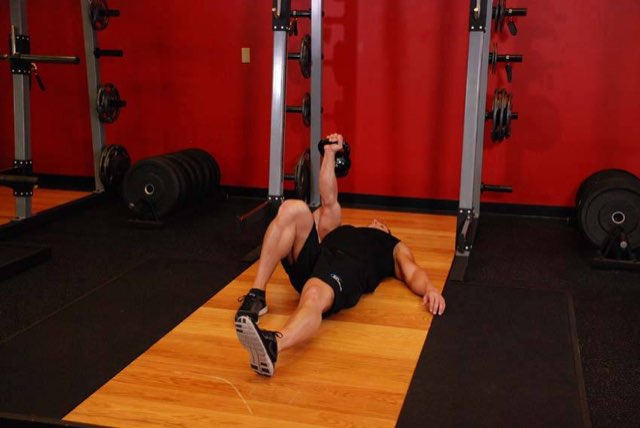
Checked automatically against the study
Your shoulders work hardest in the press to elbow and the leg sweep.
The shoulders worked hardest in the second and fifth of the 7 stages. No size of effect was reported.
This was a small study of twelve people who had done get-ups for at least a year. Each person did ten get-ups with a kettlebell in their right hand. Sensors on the skin measured how hard the shoulder muscles on both sides worked. It measured muscle effort, not muscle growth.
Who took part12 people with at least 1 year of get-up practice. The abstract doesn't give their sex or age.LimitsOnly twelve people took part.It measured how hard muscles worked, not strength or muscle growth over time.The weight was only held in the right hand.
Why this bandA one-off lab test of 12 peopleAbout this exercise: it’s in the titleAmong the top 12% most cited papers of its age
- Do both the way up and the way down with care, because both halves made the shoulder muscles work.
- Do your get-ups on both sides, because each shoulder worked differently depending on which hand was holding the weight.
- Kind of study
- A lab study
- People
- people with at least a year of get-up practice
- What they looked at
- Muscle activity
Original title: A descriptive analysis of shoulder muscle activities during individual stages of the Turkish Get-Up exercise
St-Onge E, Robb A, Beach TAC, Howarth SJ · Journal of Bodywork and Movement Therapies · Wed Jan 31 2018 · DOI 10.1016/j.jbmt.2018.01.013
Checked automatically against the study
An athlete's report says the get-up loads your shoulder and neck using little kit.
A lone athlete was described, and no size of effect was reported.
This is a report on a lone person, a competitive Brazilian Jiu-Jitsu athlete with a neck and shoulder sprain. His care team used the get-up as an exercise where the shoulder and neck hold steady under a load. The authors say it needs little space or kit and can keep being made harder. Nothing was measured or compared with another group.
Who took partA competitive Brazilian Jiu-Jitsu athlete, a man. The abstract doesn't give his age or lifting experience. No women took part.LimitsIt is about a lone person.It is a report, not a test, so nothing was compared.He was under care for a sprain, so it may not apply to healthy lifters.
Why this bandAbout a single personAbout this exercise: it’s in the titlePeople who already trainAmong the top 12% most cited papers of its age
- Pick the get-up when you have little space or kit, because it needs just a weight and room to lie down.
- Ask a qualified health professional first if your neck or shoulder is sore, because this report followed a lone person under care.
- Kind of study
- A single case
- People
- a competitive Brazilian Jiu-Jitsu athlete
Original title: Clinical application of the Turkish Get-Up to an acute shoulder injury in a competitive Brazilian Jiu-Jitsu athlete
Shaw T · Journal of Bodywork and Movement Therapies · Thu Feb 7 2019 · DOI 10.1016/j.jbmt.2019.02.002
How studies shape Body CEO
Every summary here is checked against its study before it appears: the numbers come from the study, with no promises. 316 studies in use, across 97 exercises, and this one was last checked for new research on Fri Nov 13 2026. How we review research
- 1 · FoundOn PubMed, checked for retractions
- 2 · WeighedScored Strong, Moderate or Early
- 3 · ReadPut in plain words, every number checked
- 4 · Shapes your planStrong and Moderate takeaways guide sets, reps and rest
- 5 · Eliza cites itReads our approved studies first, with the study linked