

What research says
3 studies · summaries checked against each study · How we choose studies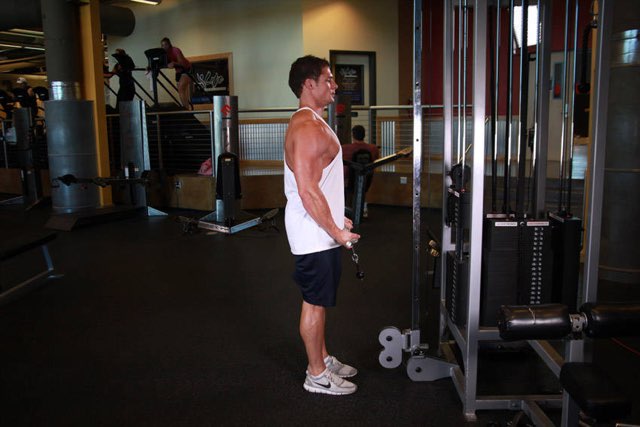
Checked automatically against the study
Pulling your arm further back on cable curls didn't add extra biceps growth.
Both arm positions grew the biceps about 7–9% over 10 weeks, with no meaningful difference between them.
In this fair test, 30 men new to lifting started and 24 finished. Each man trained one arm with the shoulder in a normal position and the other with the arm pulled as far back as it would go. Each arm was given its position by chance. Over 10 weeks, both arms grew about the same, by roughly 7 to 9%.
Who took part30 untrained men started and 24 finished; no women; the abstract doesn't give their age.LimitsOnly men new to lifting took part.6 of the 30 men didn't finish.Lasted 10 weeks.
Why this bandA randomised trial of 24 peopleAbout this exercise: it’s in the title10 weeks of trainingIn a recognised free-to-read journal (DOAJ)
- Use a comfortable shoulder position on cable curls. Stretching the arm far behind you didn't add growth here.
- Take each set to the point where you can't do another clean rep. That is how the people in this study trained.
- Kind of study
- A fair test
- People
- men new to lifting
- What they looked at
- Muscle size
Original title: The effects of shoulder extension angle on elbow flexor hypertrophy in the cable curl exercise
Larsen S, Sandvik Kristiansen B, Østerås Sandberg N and others · Frontiers in Physiology · Tue Mar 31 2026 · DOI 10.3389/fphys.2026.1750722
Checked automatically against the study
Cable curls with your arm in front or behind you grew biceps about equally.
Biceps thickness up 6–7% (arm in front) vs 9% (arm behind) over 10 weeks, with no clear difference between them.
Fifteen young men trained for 10 weeks in a fair test, with each arm given one curl by chance. One arm did cable curls with the arm out in front (a preacher curl). The other did them with the arm behind the body (a Bayesian curl). Scans showed both arms grew and got stronger by about the same amount. This was a small group.
Who took part15 young men in their mid-twenties; no women; the abstract doesn't say how trained they were.LimitsSmall group of 15 people.Only men took part.Lasted 10 weeks.
Why this bandA randomised trial of 15 peopleAbout this exercise: it’s in the title10 weeks of trainingIn a recognised free-to-read journal (DOAJ)
- Choose the cable curl angle you enjoy and can do well. Both front and behind the body worked in this study.
- Train your curls twice a week with 3 to 5 sets, using a weight you can lift 8 to 12 times.
- Kind of study
- A fair test
- People
- young men
- What they looked at
- Muscle size, strength
Original title: Comparison Between Shoulder Flexed and Extended Positions in Elbow Flexion Resistance Training on Regional Hypertrophy and Maximum Strength: Preacher versus Bayesian Cable Curls
Attarieh P, Nunes JP, Khani S and others · European Journal of Sport Science · Tue Apr 1 2025 · DOI 10.1002/ejsc.12279
Checked automatically against the study
In one session, dumbbell curls worked the biceps harder than behind-the-body cable curls.
Biceps sensor reading was 111.46% of a max squeeze in dumbbell curls vs 93.39% in Bayesian cable curls.
Eleven people did dumbbell curls and Bayesian cable curls (arm behind the body) in one lab session. Each curl used a heavy weight compared with the most they could lift once. Sensors on the skin measured how hard the biceps worked. The biceps worked harder in the dumbbell curl. This was a small study, and it measured effort, not muscle growth.
Who took part11 volunteers, average age 25. The abstract doesn't say if they were men or women, or how trained they were.LimitsVery small group of 11 people.One session only, in a lab.Measured how hard the muscle worked, not muscle growth.
Why this bandA one-off lab test of 11 peopleTests this exerciseIn a recognised free-to-read journal (DOAJ)Published recently, so not yet widely cited
- Add dumbbell curls next to your cable curls if you want some variety. They made the biceps work harder in this one test.
- Remember this study measured one session only. It didn't measure growth over weeks.
- Kind of study
- A lab study
- People
- adult volunteers
- What they looked at
- Muscle activity
Original title: An Exploratory Study of Biceps Brachii Electromyographic Activity During Traditional Dumbbell Versus Bayesian Cable Curls
Parpa K, Vasiliou A, Michaelides M and others · Muscles (Basel, Switzerland) · Mon Oct 13 2025 · DOI 10.3390/muscles4040045
How studies shape Body CEO
Every summary here is checked against its study before it appears: the numbers come from the study, with no promises. 316 studies in use, across 97 exercises, and this one was last checked for new research on Fri Nov 13 2026. How we review research
- 1 · FoundOn PubMed, checked for retractions
- 2 · WeighedScored Strong, Moderate or Early
- 3 · ReadPut in plain words, every number checked
- 4 · Shapes your planStrong and Moderate takeaways guide sets, reps and rest
- 5 · Eliza cites itReads our approved studies first, with the study linked