

Research on Push-Up · Every study we found · How we choose studies
Checked automatically against the study
Harder Push-Up versions changed how hard some shoulder blade muscles worked.
16 people did 5 reps of 3 versions; the abstract reports no size of effect.
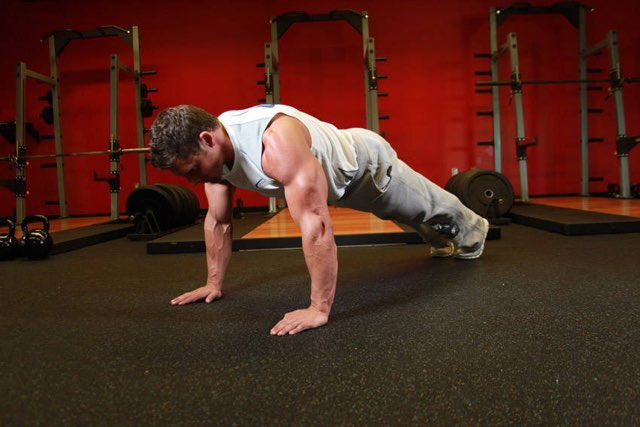
This was a small lab test with 16 people. Each person did five reps of three Push-Up versions, from easier to harder. Sensors on the skin measured how hard three muscles around the shoulder blade worked. With the feet raised, the muscle along the side of your ribs and your upper trapezius (upper back and neck muscle) worked differently. Your lower trapezius did not change.
Who took part16 people. The abstract doesn't say their sex, age or training experience.LimitsSmall group of 16 people.It measured how hard muscles worked during the test, not strength or muscle growth.The abstract doesn't say who took part.
Why this bandA one-off lab test of 16 peopleAbout this exercise: it’s in the titlePeople with a health condition, not healthy adultsAmong the top 13% most cited papers of its age
- Kind of study
- A lab study
- People
- 16 people
- What they looked at
- Muscle activity
Original title: An electromyographical analysis of the scapular stabilizing synergists during a push-up progression
Lear LJ, Gross MT · The Journal of Orthopaedic and Sports Physical Therapy · Tue Sep 1 1998 · DOI 10.2519/jospt.1998.28.3.146