

Research on Face Pull · Every study we found · How we choose studies
Checked automatically against the study
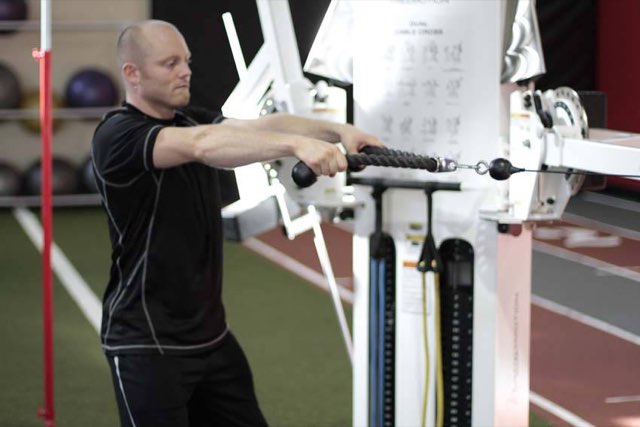
Face pulls worked the back of your shoulders about as hard as bent-over raises.
Rear shoulder force of 58.183 N in face pulls, about the same as bent-over raises (58.591 N) and more than bent-over rows (47.911 N)
This was a small lab study of ten healthy men. Instead of skin sensors, a computer model of the body estimated how hard the back of the shoulder worked from how each person moved. Face pulls and bent-over dumbbell raises worked it about the same. Both worked it more than bent-over dumbbell rows.
Who took part10 healthy men; no women. The abstract doesn't give their age or training experience.LimitsOnly ten people took part, and all were men.A computer model estimated muscle force. It wasn't measured directly, and muscle growth over time wasn't tested.The main aim was to design movement paths for machines, not to compare gym training plans.
Why this bandA one-off lab test of 10 peopleTests this exercisePublished recently, so not yet widely cited
- Use face pulls when you want to train the back of your shoulders, since they worked it as hard as bent-over raises.
- Add face pulls or bent-over raises alongside your rows, because rows worked the back of the shoulder less in this study.
- Kind of study
- A lab study
- People
- healthy men
- What they looked at
- Muscle activity
Original title: Biomechanical evaluation of posterior deltoid exercises and kinematic trajectory modeling
Zhu Q, Chen Z, Feng L · Acta of Bioengineering and Biomechanics · Mon Dec 1 2025 · DOI 10.37190/abb/217836