

What research says
3 studies · summaries checked against each study · How we choose studies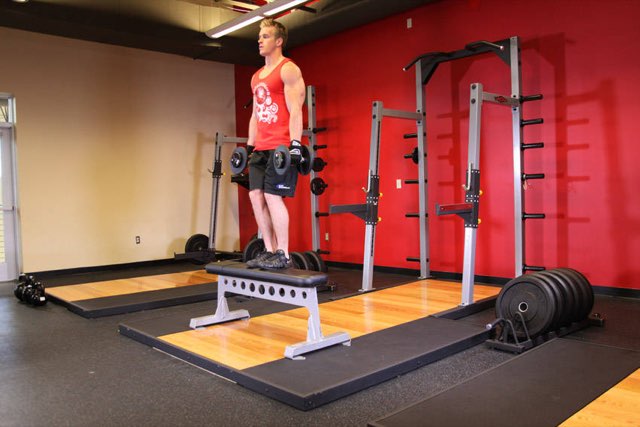
Checked automatically against the study
Four weeks of side step-ups helped people press, step and hop better.
Leg press, step-ups and hops improved after 4 weeks compared with a group that didn't train, but no size of effect was reported.
This small study compared two groups, but the abstract doesn't say people were split by chance. Twenty people did sideways step-ups for 4 weeks, and 18 people didn't train. The step-up group got better at the leg press, at step-ups and at two hopping tests. A machine test of the front of the thigh showed about the same strength as before.
Who took part20 people trained and 18 people didn't. The abstract doesn't say their sex, age or training experience.LimitsA small group, and training lasted only 4 weeks.The abstract doesn't say whether people were put into groups by chance.The abstract doesn't say who took part.
Why this bandA trial of 38 people, not put into groups by chanceAbout this exercise: it’s in the title4 weeks of trainingAmong the top 12% most cited papers of its age
- Try side step-ups (stepping up sideways onto a box) for a few weeks if you want stronger legs for pressing and hopping.
- Add weight bit by bit as the step-ups get easier, even if you do fewer reps.
- Kind of study
- A controlled test
- People
- 38 people
- What they looked at
- Strength, performance
Original title: Effect of a lateral step-up exercise protocol on quadriceps and lower extremity performance
Worrell TW, Borchert B, Erner K, Fritz J, Leerar P · The Journal of Orthopaedic and Sports Physical Therapy · Wed Dec 1 1993 · DOI 10.2519/jospt.1993.18.6.646
Checked automatically against the study
Stepping up and over a box worked your hip muscles less than lunges.
44 people tested in one session. The abstract reports no size of effect, only that Step-Up activity was lowest for most muscles.
This was a one-session lab study of 44 healthy people, half women and half men. Sensors on the skin measured how hard five hip and thigh muscles worked. The muscles were tested during a Step-Up where you step up and over a box, a lunge and a single-leg squat. For most of the muscles tested, the Step-Up asked the least of them of the three moves.
Who took part44 healthy people, 22 women and 22 men; the abstract doesn't say age or training experienceLimitsOne lab session, so it says nothing about strength or muscle growth over timeIt measured how hard muscles worked, not results from training
Why this bandA one-off lab test of 44 peopleTests this exerciseAmong the top 3% most cited papers of its age
- Kind of study
- A lab study
- People
- healthy women and men
- What they looked at
- Muscle activity
Original title: Hip-muscle activation during the lunge, single-leg squat, and step-up-and-over exercises
Boudreau SN, Dwyer MK, Mattacola CG and others · Journal of Sport Rehabilitation · Sun Feb 1 2009 · DOI 10.1123/jsr.18.1.91
Checked automatically against the study
In a lateral Step-Up, the front of your thighs did most of the work.
5 reps at 60% of a weight people could lift 5 times. The single-leg squat showed more muscle activity than the lateral Step-Up in most muscles.
This was a one-session lab study of 20 active people, 10 men and 10 women. Sensors on the skin measured how hard their leg and hip muscles worked. They did a lateral Step-Up, a forward lunge and a single-leg squat. In the lateral Step-Up, the front of the thighs worked hardest, followed by the glutes, your bum muscles.
Who took part20 active people, 10 men and 10 women; the abstract doesn't say ageLimitsSmall groupOne lab session, so it says nothing about strength gainsIt measured how hard muscles worked, not muscle growth
Why this bandA one-off lab test of 20 peopleTests this exerciseIn a recognised free-to-read journal (DOAJ)Among the top 5% most cited papers of its age
- Expect the front of your thighs to do most of the work when you do a lateral Step-Up, more than your glutes.
- Kind of study
- A lab study
- People
- active men and women
- What they looked at
- Muscle activity
Original title: Electromyographic activity in the gluteus medius, gluteus maximus, biceps femoris, vastus lateralis, vastus medialis and rectus femoris during the Monopodal Squat, Forward Lunge and Lateral Step-Up exercises
Muyor JM, Martín-Fuentes I, Rodríguez-Ridao D, Antequera-Vique JA · PloS one · Wed Apr 1 2020 · DOI 10.1371/journal.pone.0230841
How studies shape Body CEO
Every summary here is checked against its study before it appears: the numbers come from the study, with no promises. 316 studies in use, across 97 exercises, and this one was last checked for new research on Fri Nov 13 2026. How we review research
- 1 · FoundOn PubMed, checked for retractions
- 2 · WeighedScored Strong, Moderate or Early
- 3 · ReadPut in plain words, every number checked
- 4 · Shapes your planStrong and Moderate takeaways guide sets, reps and rest
- 5 · Eliza cites itReads our approved studies first, with the study linked