

What research says
3 studies · 1 review · summaries checked against each study · How we choose studiesChecked automatically against the study
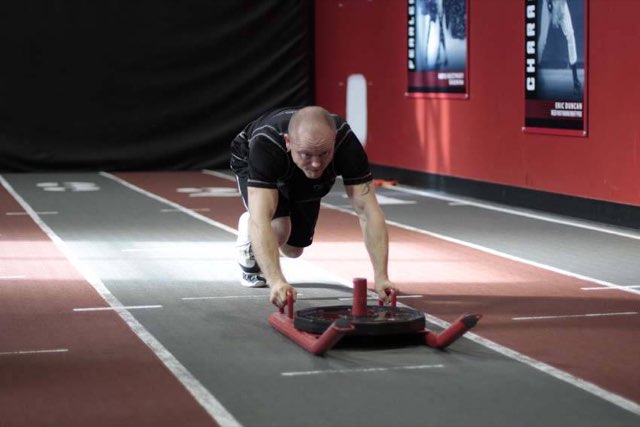
A heavy sled push before sprinting may give your next sprint a small boost.
Sleds of 50 to 75% of body weight gave the biggest sprint boost; sleds over 75% didn't help.
This was a review that pooled 23 studies with 395 people. It looked at how pushing or pulling a sled changes the sprints you do right after. Sled work gave a small boost, while sprinting free or being pulled along didn't. Pushing a sled of 50 to 75% of your body weight worked best. Pushing helped more than pulling, and very heavy sleds didn't help.
Who took part395 people across 23 studies; the abstract doesn't give their sex, age or training experience.LimitsIt only looked at sprints done right after the sled, not changes over weeks of training.The abstract doesn't say who took part.The boost it found was small.
Why this bandA review that pooled 23 studiesTests this exercisePublished recently, so not yet widely cited
- Before sprints, try one sled push of 15 to 20 metres with a sled of about 50 to 75% of your body weight.
- Rest 4 to 8 minutes before you sprint, so the boost has time to show up.
- Kind of study
- A review
- Studies pooled
- 23
- What they looked at
- Performance, how you move
Original title: Acute Effects of Assisted and Resisted Sprint Training on Subsequent Sprint Performance: A Systematic Review and Meta-Analysis
Xu K, Yin M, Zhong Y and others · Journal of Strength and Conditioning Research · Thu May 1 2025 · DOI 10.1519/jsc.0000000000005087
Checked automatically against the study
Healthy older adults handled a sled push session safely and enjoyed it.
All 36 older adults finished with no adverse events, and enjoyment was about the same as walking.
Thirty-six healthy older adults were split into two groups by chance. One group did one session of sled pushes on a special sled machine and the other walked. The sled pushes got faster in six steps, with 2 minutes of rest between them. Everyone finished, nobody was hurt, and the sled raised heart rate and effort more than walking. Fun dropped as the pushes got harder, but overall enjoyment was about the same as walking.
Who took part36 healthy older adults; the abstract doesn't give their sex or exact age.LimitsIt was only one session, so it says nothing about weeks of training.It was a small group.It used one special sled machine, which may feel different from a normal sled.
Why this bandA randomised trial of 36 peopleAbout this exercise: it’s in the titleAmong the top 11% most cited papers of its age
- Build up slowly, starting with easier pushes and rest about 2 minutes between them.
- Expect the hardest pushes to feel tough in the moment, even if you enjoy the session overall.
- Kind of study
- A fair test
- People
- healthy older adults
Original title: An Investigation of the Sled-Push Exercise Using a Resisted Sled Machine in Apparently Healthy Older Adults: An Exploratory Study
Baumann M, Hill C, Camic C and others · Journal of Aging and Physical Activity · Sat Feb 10 2024 · DOI 10.1123/japa.2023-0071
Checked automatically against the study
Seeing your power live on a screen helped people push the sled harder.
Top power was higher with live feedback at both of 2 resistance levels in 30 players; no percent was reported.
Thirty male college football players each did 10-metre pushes on a smart sled. They did them once with live power numbers on a screen and once without, in random order. With the live numbers, their top power was higher at both an easy and a harder setting.
Who took part30 healthy male college football players, college age; no women.LimitsOnly young men who play football took part.It used one special smart sled with motors, not a normal weighted sled.It looked at single sessions, not changes over weeks of training.
Why this bandA randomised trial of 30 peopleTests this exercisePeople who already trainIn a recognised free-to-read journal (DOAJ)
- If your sled or gym has a screen that shows your power or speed, watch it and try to beat your last push.
- Rest about 3 minutes between hard pushes so each one can be a strong effort.
- Kind of study
- A fair test
- People
- young male football players
- What they looked at
- Performance
Original title: Effect of Real-Time Feedback on Power Output Using a Novel Smart-Resisted Sled Push
Goldman P, Pandit B, Gomez D and others · International Journal of Exercise Science · Thu Dec 1 2022 · DOI 10.70252/hmxe1078
How studies shape Body CEO
Every summary here is checked against its study before it appears: the numbers come from the study, with no promises. 316 studies in use, across 97 exercises, and this one was last checked for new research on Fri Nov 13 2026. How we review research
- 1 · FoundOn PubMed, checked for retractions
- 2 · WeighedScored Strong, Moderate or Early
- 3 · ReadPut in plain words, every number checked
- 4 · Shapes your planStrong and Moderate takeaways guide sets, reps and rest
- 5 · Eliza cites itReads our approved studies first, with the study linked