

What research says
3 studies · summaries checked against each study · How we choose studies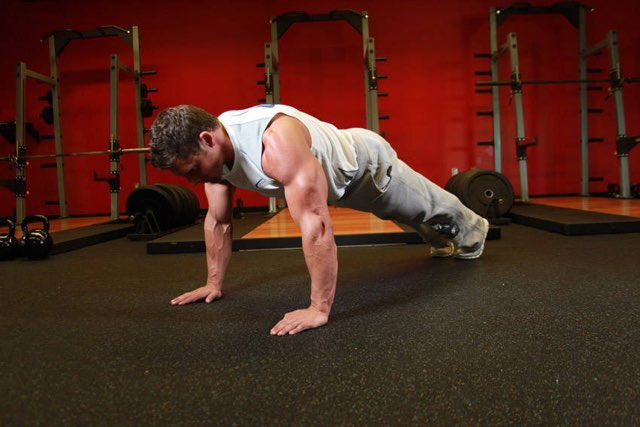
Checked automatically against the study
Heavy band push-ups built strength about as well as bench press in trained lifters.
Strength rose between 13.65% and 22.21% in 5 weeks, similar to bench press; no change in the group that didn't train.
This was a fair test (people were split into groups by chance) with 30 university students who already lifted. For 5 weeks, one group did bench press and another did push-ups with an elastic band for extra load. Both used a weight they could lift 6 times. A third group didn't train. Both training groups got stronger by about the same amount, and the non-training group didn't change. Sensors also showed the muscles worked about as hard in both exercises.
Who took part30 university students with advanced lifting experience; men and/or women and age not givenLimitsIt was short, at only 5 weeks.Groups were small, with 30 people split three ways.The push-ups were made heavy with elastic bands, so plain body-weight push-ups may differ.
Why this bandA randomised trial of 30 peopleTests this exercise5 weeks of trainingPeople who already train
- Add a resistance band across your back to make push-ups heavy enough that you can only do about 6 reps.
- Use loaded push-ups in place of bench press when you have no bench, since both built strength about equally here.
- Kind of study
- A fair test
- People
- experienced university lifters
- What they looked at
- Strength, muscle activity
Original title: Bench press and push-up at comparable levels of muscle activity results in similar strength gains
Calatayud J, Borreani S, Colado JC and others · Journal of Strength and Conditioning Research · Thu Jan 1 2015 · DOI 10.1519/jsc.0000000000000589
Checked automatically against the study
Push-ups built chest and arm muscle about as well as light bench press.
The most people could bench once rose from 61.1 kg to 64.2 kg after 8 weeks of push-ups, similar to the bench press group.
This was a small fair test (people were split into groups by chance) with 18 young men. For 8 weeks, twice a week, half did bench press at a light weight. The other half did push-ups, made easier where needed (such as on the knees) to match that load. Both groups got stronger and grew their chest and the backs of their arms by about the same amount. Only the bench press group grew the fronts of their arms. Neither group got better at a ball throw or at doing more reps.
Who took part18 men, 19 to 22 years; no women; training experience not givenLimitsIt was small, with 9 men in each group.Only young men took part.There was no group that didn't train to compare with.
Why this bandA randomised trial of 18 peopleTests this exercise8 weeks of trainingIn a recognised free-to-read journal (DOAJ)
- Use push-ups to build your chest and the backs of your arms when you can't get to a bench.
- Pick a push-up version, such as on your knees, that matches how strong you are now.
- Kind of study
- A fair test
- People
- young men aged 19 to 22
- What they looked at
- Muscle size, strength, performance
Original title: Low-load bench press and push-up induce similar muscle hypertrophy and strength gain
Kikuchi N, Nakazato K · Journal of Exercise Science and Fitness · Thu Jun 29 2017 · DOI 10.1016/j.jesf.2017.06.003
Checked automatically against the study
A Push-Up with an extra shoulder blade push worked the side rib muscle hardest.
Side rib muscle worked up to 123% (on the study's scale) in the standard Push-Up with extra shoulder push, the highest of the versions tested
This was a small lab study of 30 people. Some were healthy and some had mild shoulder problems. Sensors on the skin measured how hard muscles worked across several Push-Up versions. They measured the muscle along the side of your ribs that moves your shoulder blade. They also measured the top of your shoulders near your neck. The standard Push-Up, with an extra push of the shoulder blades forward at the top, made the side rib muscle work hardest. It also kept the top of the shoulders quietest.
Who took part30 people, healthy or with mild shoulder problems; the abstract doesn't say their sex, age or training experienceLimitsMeasured how hard muscles worked during the session, not strength or growthSmall groupPartly aimed at people with shoulder problems, which is a clinical setting
Why this bandA one-off lab test of 30 peopleAbout this exercise: it’s in the titleAmong the top 1% most cited papers of its age
- Kind of study
- A lab study
- People
- healthy people and people with mild shoulder problems
- What they looked at
- Muscle activity
Original title: Relative balance of serratus anterior and upper trapezius muscle activity during push-up exercises
Ludewig PM, Hoff MS, Osowski EE, Meschke SA, Rundquist PJ · The American Journal of Sports Medicine · Mon Mar 1 2004 · DOI 10.1177/0363546503258911
How studies shape Body CEO
Every summary here is checked against its study before it appears: the numbers come from the study, with no promises. 316 studies in use, across 97 exercises, and this one was last checked for new research on Fri Nov 13 2026. How we review research
- 1 · FoundOn PubMed, checked for retractions
- 2 · WeighedScored Strong, Moderate or Early
- 3 · ReadPut in plain words, every number checked
- 4 · Shapes your planStrong and Moderate takeaways guide sets, reps and rest
- 5 · Eliza cites itReads our approved studies first, with the study linked