

What research says
2 studies · summaries checked against each study · How we choose studies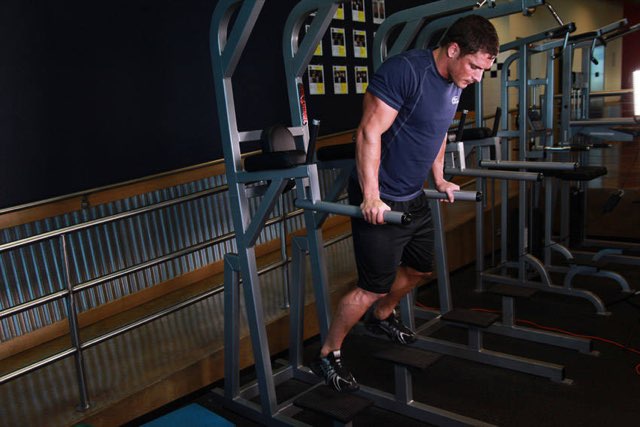
Checked automatically against the study
When dips get tiring, your chest and triceps work harder and your form mostly holds.
Chest and triceps worked harder in the last 3 reps than in reps 2 to 4; no size of effect was reported.
This was a one-session lab test with 15 healthy men. Each man did one set of dips until he couldn't do any more. Sensors on the skin measured how hard nine muscles worked, and cameras tracked how they moved. In the last reps, the chest and triceps worked harder than in the early reps, and each rep took longer.
Who took part15 healthy men; no women; age and training experience not given.LimitsIt was a small group of only men.It was one session in a lab, not weeks of training.It measured how hard muscles worked, not muscle growth.
Why this bandA one-off lab test of 15 peopleAbout this exercise: it’s in the titleAmong the top 7% most cited papers of its age
- Take your sets of dips close to your limit if you want your chest and triceps to work hard.
- As you tire, check your body position at the top of each rep, because that part changed.
- Kind of study
- A lab study
- People
- healthy men
- What they looked at
- Muscle activity, how you move
Original title: Fatigue Increases Muscle Activations but Does Not Change Maximal Joint Angles during the Bar Dip
McKenzie A, Crowley-McHattan Z, Meir R, Whitting J, Volschenk W · International Journal of Environmental Research and Public Health · Thu Nov 3 2022 · DOI 10.3390/ijerph192114390
Checked automatically against the study
A young recruit got a small breastbone crack while doing wide-grip dips.
This is a case of a breastbone stress crack during wide-grip dips; no size of effect was reported.
This is a case report about a young man, a military recruit. He did dips with a grip wider than his shoulders and heard a click at the front of his chest. He felt no pain at the time. A scan later showed a small stress crack in the top of his breastbone, which the authors call rare.
Who took partA young man, a military recruit; no women.LimitsIt is about just this young man, not a group of people.He was a very active military recruit, so this may not apply to most gym-goers.It can't show that the wide grip caused the crack.
Why this bandAbout a single personAbout this exercise: it’s in the titleAmong the top 13% most cited papers of its age
- If you hear a click at the front of your chest during dips, get it checked by a qualified health professional, even if it doesn't hurt.
- Kind of study
- A single case
- People
- a young male military recruit
Original title: Stress fracture of the manubrium sterni during parallel bar dips
Demir Benli M · The Physician and Sportsmedicine · Wed Mar 8 2023 · DOI 10.1080/00913847.2023.2188047
How studies shape Body CEO
Every summary here is checked against its study before it appears: the numbers come from the study, with no promises. 316 studies in use, across 97 exercises, and this one was last checked for new research on Fri Nov 13 2026. How we review research
- 1 · FoundOn PubMed, checked for retractions
- 2 · WeighedScored Strong, Moderate or Early
- 3 · ReadPut in plain words, every number checked
- 4 · Shapes your planStrong and Moderate takeaways guide sets, reps and rest
- 5 · Eliza cites itReads our approved studies first, with the study linked