

What research says
3 studies · summaries checked against each study · How we choose studies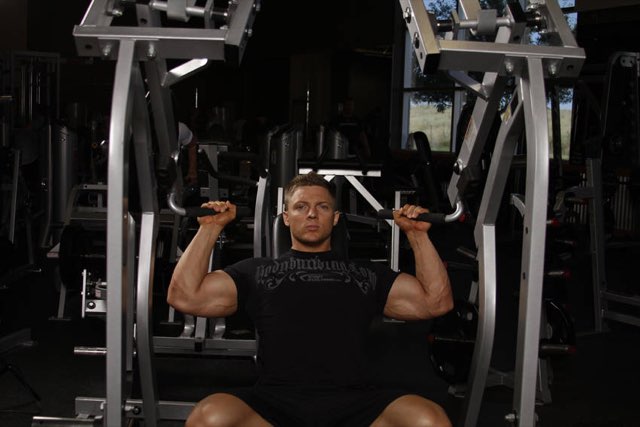
Checked automatically against the study
Thinking about your shoulders made them work harder on the machine shoulder press.
Shoulder muscles worked harder when people focused on them, at 40% of the most they could lift once. No size of effect was reported.
Thirty-one young adults who had never lifted did machine shoulder presses with a light weight in one session. They pressed with no focus, then while focusing on their shoulders, then on the backs of their arms. Sensors on the skin measured how hard each muscle worked. The muscle they focused on worked harder, while the upper back muscle near the neck didn't change.
Who took part31 healthy young adults with no training experience; the abstract doesn't say how many were men or womenLimitsOne session only, so it doesn't show long-term strength or muscle growth.Used a light weight with people new to lifting.Measured how hard muscles worked, not muscle growth.
Why this bandA one-off lab test of 31 peopleAbout this exercise: it’s in the titlePublished recently, so not yet widely cited
- Think about your shoulder muscles as you press, if building your shoulders is your goal.
- Try this with a lighter weight first, where it was tested.
- Kind of study
- A lab study
- People
- young adults new to lifting
- What they looked at
- Muscle activity
Original title: Effects of Mind-Muscle Connection on Muscle Activity During Machine-Based Shoulder Press in Untrained Individuals
Kim D, Woo J, Lee S and others · Journal of Clinical Medicine · Wed May 20 2026 · DOI 10.3390/jcm15103925
Checked automatically against the study
Shoulder press bar speed closely tracks how heavy the weight is for you.
The most people could press once rose about 17.5% after 10 weeks of speed-guided training.
In total, 48 athletes with low to high strength did a barbell shoulder press, building up to the most they could lift once. How fast the bar moved closely matched how heavy the weight was for each person. Then 24 of them did 10 weeks of training guided by bar speed. Their best lift went up by about a sixth, and the slowest point of each heavy rep came a bit under halfway up.
Who took part48 athletes with low to high strength; the abstract doesn't give sex or ageLimitsUsed a barbell press, not a machine.The abstract mentions no comparison group for the 10-week training part.Sex and age of the athletes are not reported.
Why this bandCompared 48 people at one point in timeOnly mentions this exercise in passingPeople who already trainIn a recognised free-to-read journal (DOAJ)
- Expect the press to slow down around the middle of a heavy rep, and keep pushing through that sticky point.
- Watch your rep speed: when reps slow right down, you are close to your limit.
- Kind of study
- A one-time comparison
- People
- athletes of different strength levels
- What they looked at
- Strength, how you move
Original title: A comprehensive analysis of the velocity-based method in the shoulder press exercise: stability of the load-velocity relationship and sticking region parameters
Hernández-Belmonte A, Martínez-Cava A, Morán-Navarro R, Courel-Ibáñez J, Pallarés JG · Biology of Sport · Mon Aug 31 2020 · DOI 10.5114/biolsport.2020.98453
Checked automatically against the study
Pressing on a Swiss ball didn't make your shoulders work harder than a bench.
About the same muscle work on a Swiss ball as on a bench, using 80% of the most each man could lift once. No size of effect was reported.
Sixteen healthy men did dumbbell shoulder presses and chest presses on a bench and on a Swiss ball. Sensors on the skin measured how hard the front shoulder, chest and stomach muscles worked. The muscles worked about the same on both surfaces. It was a small, one-session lab study.
Who took part16 healthy men; no women; training experience not statedLimitsSmall group of men only, tested in one session.Used dumbbells, not a shoulder press machine.Measured how hard muscles worked, not muscle growth or strength gains.
Why this bandA one-off lab test of 16 peopleOnly mentions this exercise in passingAmong the top 9% most cited papers of its age
- Use a stable seat, like the one on your machine, because a wobbly surface didn't add extra shoulder work here.
- Pick the setup you feel steady on and focus on lifting well.
- Kind of study
- A lab study
- People
- healthy young men
- What they looked at
- Muscle activity
Original title: Muscle activation when performing the chest press and shoulder press on a stable bench vs. a Swiss ball
Uribe BP, Coburn JW, Brown LE and others · Journal of Strength and Conditioning Research · Thu Apr 1 2010 · DOI 10.1519/jsc.0b013e3181ca4fb8
How studies shape Body CEO
Every summary here is checked against its study before it appears: the numbers come from the study, with no promises. 316 studies in use, across 97 exercises, and this one was last checked for new research on Fri Nov 13 2026. How we review research
- 1 · FoundOn PubMed, checked for retractions
- 2 · WeighedScored Strong, Moderate or Early
- 3 · ReadPut in plain words, every number checked
- 4 · Shapes your planStrong and Moderate takeaways guide sets, reps and rest
- 5 · Eliza cites itReads our approved studies first, with the study linked