

What research says
3 studies · 1 review · summaries checked against each study · How we choose studiesChecked automatically against the study
Adding bridges to hospital care helped people after a stroke stand up more evenly.
After 4 weeks, the gap in push between the two feet was about 5 in the bridge group, against 17.1 with usual care alone.
This was a fair test with 48 people in hospital after a recent stroke. Half did 30 minutes of bridges that got harder over time, on top of their usual care. The other half had only their usual care. After 4 weeks, the bridge group pushed through both feet more evenly when standing up from a chair. They also scored higher on a standing-up test.
Who took part48 people in hospital after a recent stroke; men or women and age not givenLimitsIt took place in a hospital, with people recovering from a stroke, not a gym.Bridges were added on top of 45 minutes of usual care.5 people dropped out.
Why this bandA randomised trial of 48 peopleAbout this exercise: it’s in the title8 weeks of trainingPeople with a health condition, not healthy adults
- Make your bridges harder step by step, as this study did.
- If you are recovering from a stroke, ask your care team whether bridges fit your plan.
- Kind of study
- A fair test
- People
- people in hospital after a stroke
- What they looked at
- How you move, performance
Original title: Effect of progressive bridging exercise on weight-bearing during the extension phase of sit-to-stand, and on sit-to-stand ability in individuals with stroke: A randomised controlled trial
Pankheaw T, Hiengkaew V, Bovonsunthonchai S, Tretriluxana J · Clinical Rehabilitation · Mon Jul 11 2022 · DOI 10.1177/02692155221107107
Checked automatically against the study
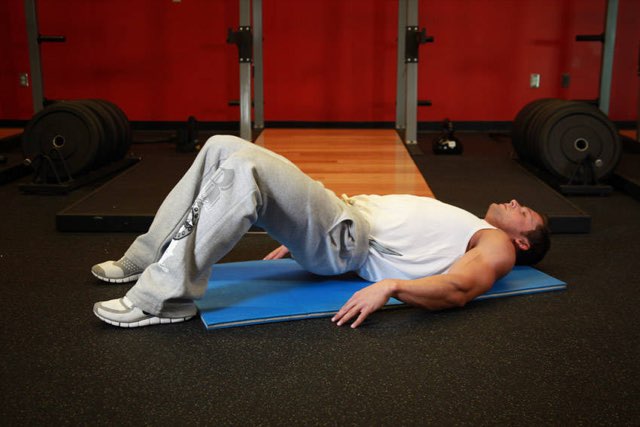
Glute bridges before sprinting gave teenage footballers a small sprint boost.
Bridges at 84% or 60% of the most they could lift gave a small 30 m sprint gain over the no-exercise group. No exact size was given.
This was a fair test (people were split into groups by chance) with teenage boys who play football. Thirteen did heavy glute bridges, 13 did hip thrusts and 14 did no exercise. Each group then ran sprints after a 7-minute rest. Bridges and hip thrusts both gave a similar short warm-up boost to sprinting, while the group that did nothing barely changed.
Who took partTeenage boys who play football, in groups of 13, 13 and 14; no women; exact age and lifting experience not givenLimitsOnly one session, so it shows the effect right after, not over weeks of training.Only teenage boys took part.Each group was small.
Why this bandA randomised trial of 40 peopleAbout this exercise: it’s in the titleChildren or teenagers, not adultsIn a recognised free-to-read journal (DOAJ)
- Try a few heavy glute bridges about 7 minutes before you sprint, as a warm-up boost.
- Use bridges in place of hip thrusts if you prefer them, since both worked about the same here.
- Kind of study
- A fair test
- People
- teenage boy footballers
- What they looked at
- Performance
Original title: The Acute Effects Of Hip Thrust and Glute Bridge Exercises With Different Loads on Sprint Performance and Horizontal Force-Velocity Profile in Adolescent Soccer Players: A Post-Activation Performance Enhancement Approach
Çabuk S, İnce İ · European Journal of Sport Science · Sat Feb 1 2025 · DOI 10.1002/ejsc.12255
Checked automatically against the study
A review describes many ways to set up the Glute Bridge.
Covers 5 versions of the bridge; no size of effect was reported.
This is a review that sums up earlier work without pooling it. It describes how changing your ankle, knee, hip and back angles changes the Glute Bridge. It also looks at past studies of how hard different muscles work during the Glute Bridge. The authors meant it as a guide for clinical settings, and they gave no numbers.
Who took partThe abstract doesn't sayLimitsIt is a narrative review, so it doesn't pool results.No new people were tested.It is written for clinical settings, not gym training.
Why this bandAn expert’s overview, not a pooled reviewAbout this exercise: it’s in the titlePublished recently, so not yet widely cited
- Kind of study
- A review
- What they looked at
- Muscle activity
Original title: Supine Bridge Exercise: A Narrative Review of the Literature (Part I)
Colonna S, D'Alessandro A, Tarozzi R, Casacci F · Cureus · Mon Mar 10 2025 · DOI 10.7759/cureus.80349
How studies shape Body CEO
Every summary here is checked against its study before it appears: the numbers come from the study, with no promises. 316 studies in use, across 97 exercises, and this one was last checked for new research on Fri Nov 13 2026. How we review research
- 1 · FoundOn PubMed, checked for retractions
- 2 · WeighedScored Strong, Moderate or Early
- 3 · ReadPut in plain words, every number checked
- 4 · Shapes your planStrong and Moderate takeaways guide sets, reps and rest
- 5 · Eliza cites itReads our approved studies first, with the study linked