

What research says
3 studies · summaries checked against each study · How we choose studiesChecked automatically against the study
Dumbbell and cable lateral raises grew the side of the shoulder about equally.
Side shoulder muscle grew about 3.3% to 4.6% thicker, about the same with dumbbells or cable.
Twenty-four men and women who already lift took part. Each person trained an arm with dumbbells and the other arm with a cable. They did five sets of lateral raises to failure, twice a week. Both arms used the same range of motion. An ultrasound scan showed the side shoulder muscle got a bit thicker. Both tools did about the same.
Who took part24 men and women who already lift. The abstract doesn't say their ages.LimitsIt was a small group.It was a short study.Only people who already lift took part.
Why this bandA randomised trial of 24 peopleAbout this exercise: it’s in the titlePeople who already trainIn a recognised free-to-read journal (DOAJ)
- Use dumbbells or a cable, whichever you like or have to hand. Both grew the shoulder about equally.
- Do several hard sets close to failure, twice a week, as people did here.
- Kind of study
- A fair test
- People
- trained men and women
- What they looked at
- Muscle size
Original title: Dumbbell versus cable lateral raises for lateral deltoid hypertrophy: an experimental study
Larsen S, Wolf M, Schoenfeld BJ and others · Frontiers in Physiology · Mon Jul 7 2025 · DOI 10.3389/fphys.2025.1611468
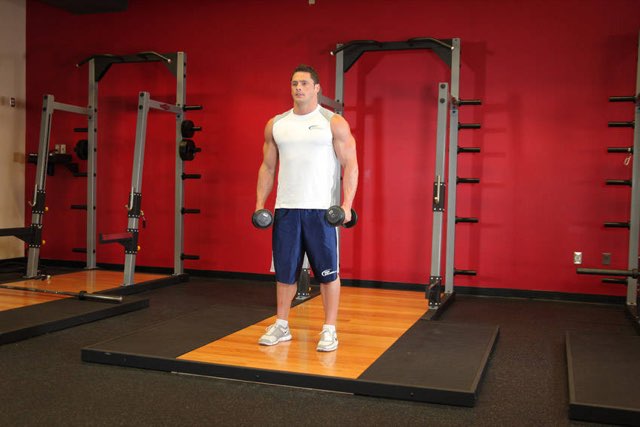
Checked automatically against the study
Hard, interval-style arm-raise training lifted shoulder endurance in people with long-term shoulder pain.
About 233 seconds more arm-raising endurance than usual care alone, over 8 weeks
This was a small fair test (people were split into groups by chance) with 21 people who had long-lasting pain around the top of the shoulder. One group added hard interval training for the shoulder muscles to their usual care for 8 weeks. The other group had usual care only. The interval group could keep raising their arm out to the side for much longer, and they reported less pain and less trouble using their shoulder.
Who took part21 people with long-term shoulder pain; the abstract doesn't say their sex, age or training experienceLimitsSmall group, with only 8 people in the comparison groupEveryone had shoulder pain, so results may differ for people without itOnly 8 weeks long
Why this bandA randomised trial of 21 peopleTests this exercise8 weeks of trainingAmong the top 12% most cited papers of its age
- Get advice from a qualified health professional first if your shoulder hurts, before you train it hard.
- Know that in this group, hard shoulder work was done as part of usual care, not on its own.
- Kind of study
- A fair test
- People
- adults with long-term shoulder pain
- What they looked at
- Performance
Original title: High-Intensity Shoulder Abduction Exercise in Subacromial Pain Syndrome
Berg OK, Paulsberg F, Brabant C and others · Medicine and Science in Sports and Exercise · Fri Jan 1 2021 · DOI 10.1249/mss.0000000000002436
Checked automatically against the study
A bent-over Dumbbell Lateral Raise worked the back of the shoulder hard.
Back-of-shoulder force about 58.591 N in the bent-over version vs 47.911 N in the bent-over row
Ten healthy men did a bent-over version of the Dumbbell Lateral Raise, a standing face pull and a bent-over dumbbell row. Researchers filmed their movement and used a computer model to estimate how hard the back of the shoulder worked. The bent-over Dumbbell Lateral Raise and the face pull came out about the same, and both beat the row. It was a small study meant to help program rehab robots.
Who took part10 healthy men; no women; age and training experience not givenLimitsSmall group of 10 men, no womenMuscle force was estimated by a computer model, not measured directlyTested only the bent-over version, not the standing Dumbbell Lateral Raise
Why this bandA one-off lab test of 10 peopleTests this exercisePublished recently, so not yet widely cited
- Kind of study
- A lab study
- People
- healthy men
- What they looked at
- Muscle activity
Original title: Biomechanical evaluation of posterior deltoid exercises and kinematic trajectory modeling
Zhu Q, Chen Z, Feng L · Acta of Bioengineering and Biomechanics · Mon Dec 1 2025 · DOI 10.37190/abb/217836
How studies shape Body CEO
Every summary here is checked against its study before it appears: the numbers come from the study, with no promises. 316 studies in use, across 97 exercises, and this one was last checked for new research on Fri Nov 13 2026. How we review research
- 1 · FoundOn PubMed, checked for retractions
- 2 · WeighedScored Strong, Moderate or Early
- 3 · ReadPut in plain words, every number checked
- 4 · Shapes your planStrong and Moderate takeaways guide sets, reps and rest
- 5 · Eliza cites itReads our approved studies first, with the study linked