

What research says
3 studies · summaries checked against each study · How we choose studies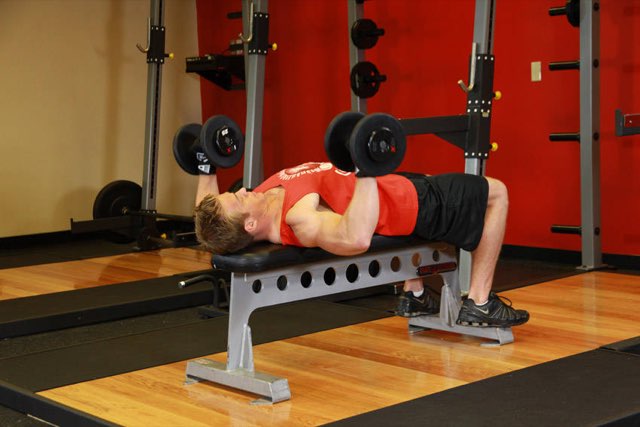
Checked automatically against the study
Dumbbell bench press left trained men with no triceps soreness, unlike barbell versions.
Dumbbell group had no triceps soreness; barbell and Smith machine groups took 72 hours to recover from theirs
This was a small fair test. Twenty-seven men who already lift were split by chance into three groups: Smith machine, barbell or dumbbell bench press. Each group did 8 hard sets of 10. Then the researchers tracked chest and arm strength, muscle swelling and soreness for 96 hours. Recovery of strength and chest soreness was about the same in all three groups. The dumbbell group, though, felt no triceps soreness at all.
Who took part27 trained men, 23.5 years old on average; no womenLimitsSmall group, split across three exercisesOnly men who already liftLooked at one hard workout, not weeks of training
Why this bandA randomised trial of 27 peopleTests this exercisePeople who already trainAmong the top 12% most cited papers of its age
- Choose dumbbells on days when you want your triceps less sore afterwards, for example before an arm session.
- Plan your rest as you would for barbell bench, because chest strength recovered at about the same pace.
- Kind of study
- A fair test
- People
- young men who lift
- What they looked at
- Strength
Original title: Chest Press Exercises With Different Stability Requirements Result in Similar Muscle Damage Recovery in Resistance-Trained Men
Ferreira DV, Ferreira-Júnior JB, Soares SR and others · Journal of Strength and Conditioning Research · Sun Jan 1 2017 · DOI 10.1519/jsc.0000000000001453
Checked automatically against the study
Pressing dumbbells on a Swiss ball worked your chest about the same as a bench.
About the same muscle work on a Swiss ball as on a bench at 80% of the most they could lift; no size of effect was reported
Sixteen healthy young men pressed heavy dumbbells for 3 reps on a normal bench and on a Swiss ball. Sensors on the skin measured how hard the chest, front shoulders and belly muscles worked. There was about the same amount of muscle work on both surfaces. This was a small, one-off lab test, so it shows how hard muscles worked, not muscle growth.
Who took part16 healthy young men, 24.19 years old on average; no women; training experience not statedLimitsSmall group of only menJust 3 reps per test in one sessionMeasured how hard muscles worked, not growth or strength gains
Why this bandA one-off lab test of 16 peopleTests this exerciseAmong the top 9% most cited papers of its age
- Stick with a stable bench for your dumbbell press, because a Swiss ball didn't make your chest work harder.
- Use a Swiss ball only if you enjoy the variety, not to get more chest work.
- Kind of study
- A lab study
- People
- healthy young men
- What they looked at
- Muscle activity
Original title: Muscle activation when performing the chest press and shoulder press on a stable bench vs. a Swiss ball
Uribe BP, Coburn JW, Brown LE and others · Journal of Strength and Conditioning Research · Thu Apr 1 2010 · DOI 10.1519/jsc.0b013e3181ca4fb8
Checked automatically against the study
Flat dumbbell bench worked the chest well and the front shoulders least.
12 women who lift and 12 new to lifting; flat bench worked the front shoulders least of all the presses; no size of effect was reported
Twelve college-aged women who lift and twelve who were new to it did dumbbell flat bench, incline and shoulder presses. Sensors on the skin measured how hard each muscle worked. The flat and incline presses worked the middle of the chest more than the shoulder press did. The flat bench worked the front shoulders least of all the presses. The upper chest worked hardest while lowering on the incline, but while lifting it worked harder on the flat bench.
Who took partCollege-aged women, 12 who lift and 12 new to lifting; no menLimitsSmall group of only young womenMeasured only the dominant armMeasured how hard muscles worked, not muscle growth
Why this bandA one-off lab test of 24 peopleTests this exerciseAmong the top 13% most cited papers of its age
- Use the flat dumbbell bench when you want lots of chest work and less front-shoulder work.
- Add incline presses with a slow lowering if you want extra upper-chest work.
- Kind of study
- A lab study
- People
- college-aged women
- What they looked at
- Muscle activity
Original title: Shoulder Muscle Activation of Novice and Resistance Trained Women during Variations of Dumbbell Press Exercises
Luczak J, Bosak A, Riemann BL · Journal of Sports Medicine (Hindawi Publishing Corporation) · Wed May 15 2013 · DOI 10.1155/2013/612650
How studies shape Body CEO
Every summary here is checked against its study before it appears: the numbers come from the study, with no promises. 316 studies in use, across 97 exercises, and this one was last checked for new research on Fri Nov 13 2026. How we review research
- 1 · FoundOn PubMed, checked for retractions
- 2 · WeighedScored Strong, Moderate or Early
- 3 · ReadPut in plain words, every number checked
- 4 · Shapes your planStrong and Moderate takeaways guide sets, reps and rest
- 5 · Eliza cites itReads our approved studies first, with the study linked