

What research says
3 studies · summaries checked against each study · How we choose studiesWhat this means in the gym
4 takeaways · from the 3 studies belowDrive up out of the bottom with intent.
In trained players, the thigh and bum muscles worked harder on the way up than on the way down.
Based onStudy 3Try your back foot on a Swiss ball for extra front-thigh work with no added weight.
Front thighs worked hardest while lowering with the back foot on a Swiss ball rather than a bench.
Study 3Before jumping, do a few short loaded split squat holds, then rest a few minutes.
In regular split squats, loaded holds gave a short boost to jump height, but unweighted holds did not.
Study 2On tired or busy weeks, swap some reps for strong still holds.
Young footballers who used split squat holds kept pace with those doing moving reps over six weeks.
Study 1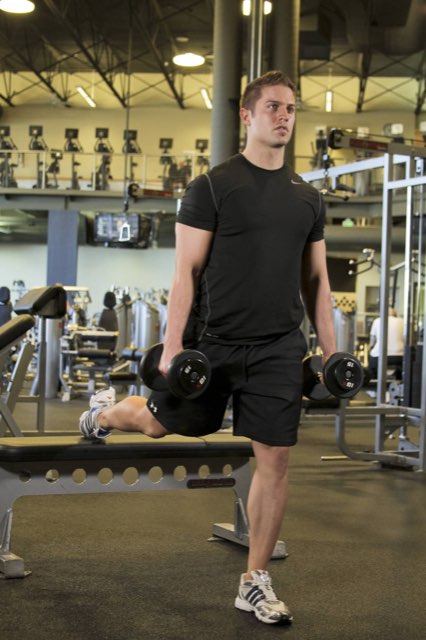
Checked automatically against the study
Split squat holds worked about as well as moving reps over six weeks.
There was no clear difference between holds and moving reps after 12 sessions over 6 weeks. The size of the strength gain wasn't reported.
This was a small fair test (people were split into groups by chance) with 18 young academy footballers. Over six weeks, half did split squats, hip thrusts and pulls as still holds. The other half did them as normal moving reps. Both groups got stronger on a trap bar lift over time. They also jumped higher and sprinted faster, and both groups ended up about the same.
Who took part18 male academy soccer players with an average age of 17.2; no womenLimitsVery small, with 9 people per group.Short, at only six weeks.The split squat was done alongside pulls and hip thrusts, so its own effect can't be separated out.
Why this bandA randomised trial of 18 peopleOnly mentions this exercise in passing6 weeks of trainingPeople who already train
- When you feel tired or busy, swap some moving split squat reps for strong holds to keep your strength going.
- Use holds as one tool in a plan with other lifts, as this study did.
- Kind of study
- A fair test
- People
- male academy soccer players
- What they looked at
- Strength, performance
Original title: Effect of Six Weeks' Isometric Strength Training Compared to Traditional Strength Training on Gains in Strength, Power, and Speed in Male Academy Soccer Players
Bailey LS, Phillips J, Farrell G, McQuilliam SJ, Erskine RM · Research Quarterly for Exercise and Sport · Thu Apr 24 2025 · DOI 10.1080/02701367.2025.2488843
Checked automatically against the study
Loaded split squat holds briefly boosted jump height, but holding longer didn't add more.
Jump height on the standard both-feet jump rose after holds with 60% of the most they could lift once. Unweighted holds gave no gain. The size was described only as moderate to large.
Twenty men who exercise for fun tried four kinds of split squat in a lab. They used short 3 or 5 second holds, either with no weight or with 60% of the most they could lift once. They did jump tests before and a few minutes after. Jumps improved only after the loaded holds. Sensors on the skin showed that the weight made every measured muscle work harder. Longer loaded holds made some muscles work harder still.
Who took part20 recreationally active men; no women; age not statedLimitsIt was a small group of men only.It measured the effect right after, not over weeks of training.The authors call the findings exploratory.
Why this bandA one-off lab test of 20 peopleAbout this exercise: it’s in the titlePeople who already trainIn a recognised free-to-read journal (DOAJ)
- To get a short warm-up boost before jumping, use a moderate weight for a few brief split squat holds. Rest about 4 minutes, then jump.
- Choose the weight over a longer hold. Holding longer changed which muscles worked, but it didn't improve the jump.
- Kind of study
- A lab study
- People
- recreationally active men
- What they looked at
- Performance, muscle activity
Original title: Effects of External Load and Holding Duration on PAPE and Muscle Activation During Isometric Split Squat Conditioning Activity
Kang M, Kim M, Jeong Y, Park S · Medicina (Kaunas, Lithuania) · Fri May 22 2026 · DOI 10.3390/medicina62061007
Checked automatically against the study
Putting your back foot on a Swiss ball made front thighs work harder.
Front-thigh effort while lowering was highest with the back foot on a Swiss ball rather than a stable bench. No size of effect was reported (23 players).
In a single session, 23 trained male football players did bodyweight Bulgarian split squats. Their back foot rested on a stable bench, a BOSU, a Swiss ball or a TRX strap. Sensors on the skin measured how hard the thigh and bum muscles worked. This measured effort, not muscle growth. The muscles worked harder on the way up than on the way down. The front thighs worked hardest during the lowering when the back foot was on the Swiss ball.
Who took part23 trained male football players; no women; age not statedLimitsBodyweight only, so it may differ with weights.Only men, measured in a single session.It measured how hard the muscles worked, not strength or muscle growth.
Why this bandA one-off lab test of 23 peopleAbout this exercise: it’s in the titlePeople who already trainIn a recognised free-to-read journal (DOAJ)
- For more front-thigh work without adding weight, try resting your back foot on a Swiss ball.
- Push up with intent, because the muscles worked hardest on the way up.
- Kind of study
- A lab study
- People
- trained male football players
- What they looked at
- Muscle activity
Original title: Effects of rear-foot instability devices on lower-limb muscle activation during the Bulgarian split squat in male football players
Topçu H, Güngör AK, Yıldırım Y and others · Scientific Reports · Sun Dec 14 2025 · DOI 10.1038/s41598-025-32203-7
How studies shape Body CEO
Every summary here is checked against its study before it appears: the numbers come from the study, with no promises. 316 studies in use, across 97 exercises, and this one was last checked for new research on Fri Nov 13 2026. How we review research
- 1 · FoundOn PubMed, checked for retractions
- 2 · WeighedScored Strong, Moderate or Early
- 3 · ReadPut in plain words, every number checked
- 4 · Shapes your planStrong and Moderate takeaways guide sets, reps and rest
- 5 · Eliza cites itReads our approved studies first, with the study linked