

What research says
3 studies · summaries checked against each study · How we choose studiesChecked automatically against the study
Light curls with a cuff on the arm improved arm strength over 6 weeks.
60 people trained for 6 weeks; no size of effect was reported for the strength gain
This was a fair test with 60 healthy people. Half did light elbow-bending exercise, like a curl, with a cuff that limits blood flow. The other half didn't train. After 6 weeks, the cuff group had stronger arms, a better sense of where their arm was, and did better on arm tests like a modified pull-up.
Who took part60 healthy people; the abstract doesn't say their sex, age or training experienceLimitsThe other group didn't train, so we can't tell if the cuff beat normal curls.It lasted only 6 weeks.
Why this bandA randomised trial of 60 peopleTests this exercise6 weeks of trainingIts plan was registered before it began (ClinicalTrials.gov)
- Learn cuff training from a qualified coach first if you want to try it with light curls.
- Know that this study only compared cuff curls with doing nothing, not with normal curls.
- Kind of study
- A fair test
- People
- healthy people
- What they looked at
- Strength, performance, how you move
Original title: Elbow flexion training with blood flow restriction improves strength, proprioception, and performance in healthy individuals: a randomized controlled trial
Yeşilyaprak SS, Dere D · BMC Musculoskeletal Disorders · Thu Oct 16 2025 · DOI 10.1186/s12891-025-08768-9
Checked automatically against the study
Two-arm and one-arm curls built about the same arm muscle in women.
One-arm group gained 0.75 kg more in one-arm right-arm curl strength than the two-arm group, over 8 weeks
This was a fair test with young women who were new to lifting. About half did two-arm curls and half did one-arm curls. Both groups did 2 sets of 8 to 12 reps, 3 days a week, for 8 weeks. Arm muscle growth was about the same. The one-arm group got a bit stronger at one-arm curls with the right arm, but not the left.
Who took partYoung women new to lifting; no menLimitsOnly women took part.People were new to lifting.It lasted only 8 weeks.
Why this bandA randomised trial of 54 peopleTests this exercise8 weeks of trainingPublished recently, so not yet widely cited
- Use two-arm barbell curls if your main aim is bigger arms. They grew muscle as well as one-arm curls here.
- Add some one-arm curls if you want to get stronger at one-arm lifting.
- Kind of study
- A fair test
- People
- young women new to lifting
- What they looked at
- Muscle size, strength
Original title: Small muscle mass exercise enhances muscular adaptations? Effects of unilateral and bilateral biceps curl on maximum strength and muscle size changes
Kassiano W, Tricoli I, Gomes F and others · European Journal of Applied Physiology · Mon Dec 8 2025 · DOI 10.1007/s00421-025-06033-4
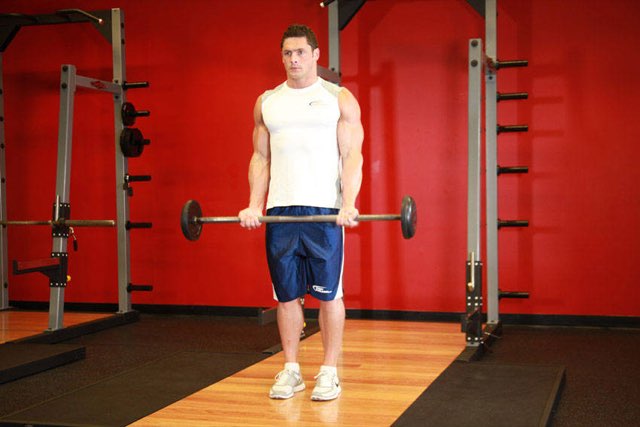
Checked automatically against the study
Barbell Curl sets to failure barely changed blood pressure, with or without arm cuffs.
Lying-down top blood pressure rose about 4 mmHg after curls without cuffs; cuffs led to fewer total reps than no cuffs.
This was a small fair test with 32 healthy young adults. Each person tried every way, in an order picked by chance. They did Barbell Curl sets until they couldn't do another rep, in three ways. Two ways used tight cuffs on the arms (blood flow restriction), and in one of them the cuff pressure was adjusted along the way. Blood pressure and artery stiffness barely changed. The adjusted cuffs felt harder and more uncomfortable, and both cuff ways meant fewer reps than going without.
Who took part32 healthy adults with an average age of 20.8, 11 of them women; training experience not stated.LimitsSmall group, and each way was tested in a single session only.The abstract calls it a biceps curl and doesn't say if a barbell was used.Only healthy young adults took part.
Why this bandA randomised trial of 32 peopleTests this exercisePublished recently, so not yet widely cited
- Kind of study
- A fair test
- People
- healthy young adults
- What they looked at
- Performance
Original title: Acute impact of autoregulation of applied blood flow restriction pressures on bilateral single-joint upper limb resistance exercise
Rolnick N, De Queiros VS, Moghaddam M and others · Journal of Sports Sciences · Sun Oct 27 2024 · DOI 10.1080/02640414.2024.2416793
How studies shape Body CEO
Every summary here is checked against its study before it appears: the numbers come from the study, with no promises. 316 studies in use, across 97 exercises, and this one was last checked for new research on Fri Nov 13 2026. How we review research
- 1 · FoundOn PubMed, checked for retractions
- 2 · WeighedScored Strong, Moderate or Early
- 3 · ReadPut in plain words, every number checked
- 4 · Shapes your planStrong and Moderate takeaways guide sets, reps and rest
- 5 · Eliza cites itReads our approved studies first, with the study linked